How to Read a Tick Titer Results
Lyme disease claret examination
Lyme disease serology; ELISA for Lyme illness; Western blot for Lyme disease
The Lyme illness claret test looks for antibodies in the blood to the leaner that causes Lyme disease. The exam is used to aid diagnose Lyme affliction.
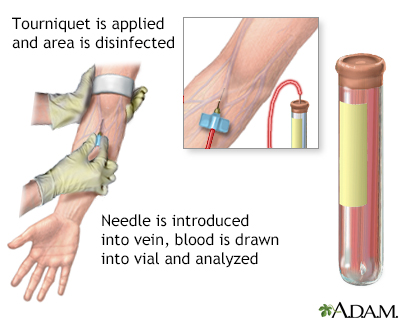
Claret is drawn from a vein (venipuncture), usually from the inside of the elbow or the back of the hand. A needle is inserted into the vein, and the blood is collected in an air-tight vial or a syringe. Grooming may vary depending on the specific test.
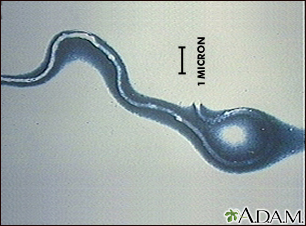
Borrelia burgdorferi is a spirochete bacteria that causes Lyme disease. It is similar in shape to the spirochetes that cause other diseases, such as relapsing fever and syphilis. (Image courtesy of the Centers for Disease Command and Prevention.)
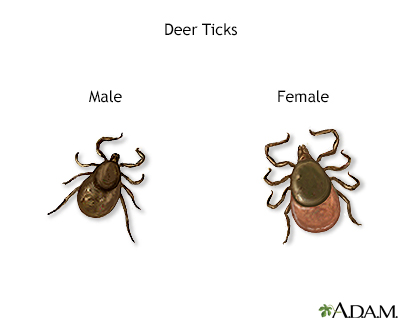
Diseases are often carried by ticks, including Rocky Mount Spotted Fever, Colorado Tick Fever, Lyme disease, and tularemia. Less common or less frequent diseases include typhus, Q-fever, relapsing fever, viral encephalitis, hemorrhagic fever, and babesiosis.
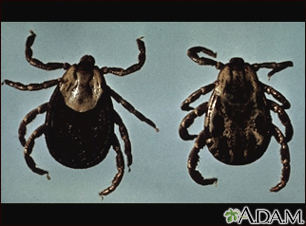
There are many species of ticks. Of these, a large proportion are capable of carrying illness. Diseases carried by ticks include Lyme disease, Erlichiosis, Rocky Mountain Spotted Fever, Colorado Tick Fever, tularemia, typhus, hemorrhagic fever, and viral encephalitis. (Image courtesy of the Centers for Disease Control and Prevention.)
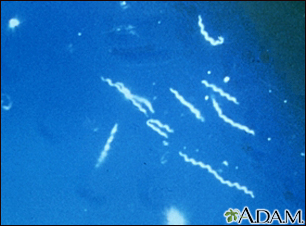
Lyme affliction is caused past a bacterium called Borrelia burgdorferi. It is known as a spirochete considering of its long, corkscrew shape. This photo shows the typical corkscrew appearance of a spirochete. (Image courtesy of the Centers for Affliction Control and Prevention.)
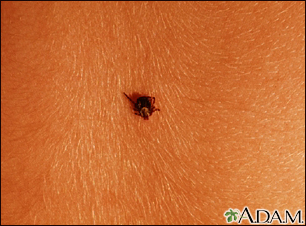
This is a close-up photograph of a tick embedded in the skin. Ticks are of import because they tin can bear diseases such as Rocky Mountain spotted fever, tularemia, Colorado tick fever, Lyme affliction, and others.
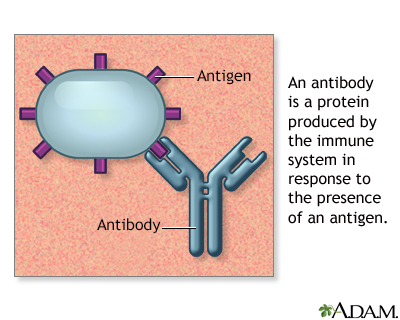
Antigens are large molecules (unremarkably proteins) on the surface of cells, viruses, fungi, bacteria, and some non-living substances such every bit toxins, chemicals, drugs, and foreign particles. The immune system recognizes antigens and produces antibodies that destroy substances containing antigens.
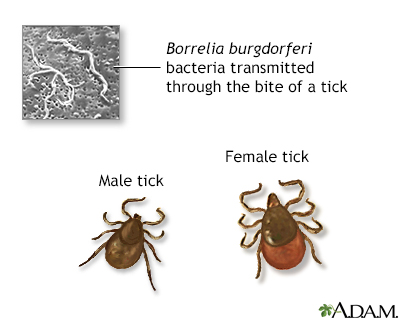
Tertiary Lyme disease is a late, persistent inflammatory disease characterized by pare changes, neurological and musculoskeletal symptoms caused by the bacterium Borrelia burgdorferi transmitted past the seize with teeth of a tick. Tertiary Lyme disease is indicated past chronic arthritis.
Having a tick attached to your torso isn't just getting a niggling also close to nature. The tick can make you lot seriously ill with Lyme affliction. Lyme disease is caused by leaner chosen Borrelia burgdorferi. Blacklegged ticks carry these bacteria. The ticks pick up the bacteria when they bite mice or deer that are infected with Lyme disease. You lot tin get the disease if you are bitten by an infected tick, mostly in northeastern states and on the West Coast. The expert news is that ordinarily a tick has to exist attached to your body for 24 to 36 hours to infect y'all. The bad news is that blacklegged ticks are so minor they're nearly incommunicable to see. Many people with Lyme disease never even see a tick on their torso. Just nigh people bitten by a tick do Non go Lyme disease. And so, how do you know for sure that you take Lyme disease? The flu-like symptoms of Lyme disease ordinarily start days or weeks after you lot've been bitten. You might take Itching all over your body; Chills, fever, and low-cal headedness; Or perhaps a Headache, muscle hurting, and a potent neck. You'll probably see a balderdash'southward eye rash on your trunk. Information technology can go pretty big. After a few weeks, the muscles in your face might feel weak or even paralyzed. Your knees and other joints may smashing and injure. You lot might even notice your heart skipping some beats. Eventually, your muscles might motion strangely, you may feel numbness or tingling, and you lot may kickoff to take problem speaking. A doctor volition test your blood for antibodies that are trying to fight the bacteria in your blood. Ane of these tests is chosen the ELISA test, and you'll often have a second test chosen the Western blot test to confirm yous have Lyme illness. To treat Lyme illness, you may need to take antibiotics for up to a month. Pain medicines from the drug store tin can help soothe your articulation stiffness. If it's defenseless early, Lyme disease is pretty easily treated. Without treatment, you tin have middle, muscle, and even nerve bug. And then the next time you're out in the woods or high grass, vesture protective wear, and do check yourself for ticks once yous get home.
How the Test is Performed
A claret sample is needed.
A laboratory specialist looks for Lyme disease antibodies in the blood sample using the ELISA examination. If the ELISA test is positive, it must be confirmed with some other test called the Western absorb exam.
How to Prepare for the Test
You exercise not need special steps to prepare for this exam.
How the Test will Feel
When the needle is inserted to draw claret, some people experience moderate pain. Others feel only a prick or stinging. Afterwards, there may exist some throbbing or a slight bruise. This soon goes away.
Why the Test is Performed
The test is done to help confirm the diagnosis of Lyme disease.
Normal Results
A negative test effect is normal. This ways none or few antibodies to Lyme disease were seen in your blood sample. If the ELISA test is negative, usually no other testing is needed.
Normal value ranges may vary slightly amongst dissimilar laboratories. Some labs employ unlike measurements or test dissimilar samples. Talk to your health care provider well-nigh the meaning of your specific test results.
What Abnormal Results Mean
A positive ELISA result is abnormal. This means antibodies were seen in your blood sample. But, this does not confirm a diagnosis of Lyme affliction. A positive ELISA consequence must be followed up with a Western blot test. Only a positive Western blot test can confirm the diagnosis of Lyme illness.
For many people, the ELISA exam remains positive, even subsequently they have been treated for Lyme disease and no longer have symptoms.
A positive ELISA test may too occur with certain diseases non related to Lyme disease, such as rheumatoid arthritis.
Risks
There is niggling take a chance involved with having your blood taken. Veins and arteries vary in size from one person to some other and from one side of the body to the other. Taking blood from some people may exist more difficult than from others.
Other risks associated with having blood drawn are slight merely may include:
- Fainting or feeling airheaded
- Multiple punctures to locate veins
- Hematoma (blood buildup nether the skin)
- Excessive bleeding
- Infection (a slight take chances any time the skin is broken)
References
LaSala PR, Loeffelholz M. Spirochete infections. In: McPherson RA, Pincus MR, eds. Henry'southward Clinical Diagnosis and Management by Laboratory Methods. 23rd ed. Philadelphia, PA: Elsevier; 2017:chap 60.
Steere Ac. Lyme disease (Lyme borreliosis) due to Borrelia burgdorferi. In: Bennett JE, Dolin R, Blaser MJ, eds. Mandell, Douglas, and Bennett's Principles and Practice of Infectious Diseases. 9th ed. Philadelphia, PA: Elsevier; 2020:chap 241.
Version Info
Final reviewed on: eleven/nine/2019
Reviewed by: Jatin K. Vyas, Physician, PhD, Assistant Professor in Medicine, Harvard Medical School; Assistant in Medicine, Division of Infectious Disease, Section of Medicine, Massachusetts General Hospital, Boston, MA. Also reviewed by David Zieve, MD, MHA, Medical Director, Brenda Conaway, Editorial Director, and the A.D.A.M. Editorial team.

Source: https://www.mountsinai.org/health-library/tests/lyme-disease-blood-test
Wow, What a Excellent post. I really found this to much informatics. It is what i was searching for.I would like to suggest you that please keep sharing such type of info.Thanks
ReplyDeleteRegards,
Blood test near me